
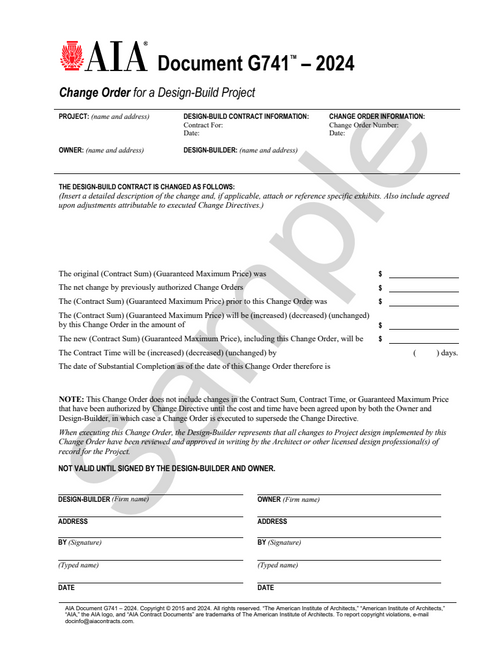
AIA Document G741 ™ 2024 is for implementing changes in the work agreed to by the owner and design-builder. Execution of a completed AIA Document G741 ™- 2024 indicates agreement upon all the terms of the change, including any changes in the contract sum or guaranteed maximum price and contract time. The form provides space for the signatures of the owner and design-builder, and for a complete description of the change.
When to use this document?
- Any size project
- Any payment method
- What is the A101-2017 Standard Form of Agreement?
The A101-2017 is a widely used contract document that establishes the terms and conditions between an owner and a contractor for a construction project. It is specifically designed for projects where the basis of payment is a stipulated sum (fixed price). - What are the key components of the A101-2017 Agreement?
- Project Details: Includes the project’s name, location, and scope.
- Contract Sum: Specifies the fixed price for the contractor’s work.
- Payment Terms: Outlines the schedule and conditions for payments.
- Commencement and Completion Dates: Defines the project timeline.
- Dispute Resolution: Provides options for resolving conflicts, such as arbitration or litigation.
- Termination Provisions: Details the conditions under which the contract can be terminated.
- How does the A101-2017 protect both owners and contractors?
- For Owners: Ensures clarity on project costs, timelines, and contractor responsibilities.
- For Contractors: Provides a clear framework for payment, dispute resolution, and scope of work, reducing the risk of misunderstandings.
- What is the difference between A101-2017 and other AIA agreements?
The A101-2017 is specifically for projects with a stipulated sum payment structure. Other agreements, like A102-2017 or A103-2017, are tailored for cost-plus or guaranteed maximum price contracts. - Can the A101-2017 be customized?
Yes, the A101-2017 can be modified to meet specific project needs. However, it is recommended to consult legal counsel to ensure compliance with local laws and project requirements. - What are the insurance and bond requirements in the A101-2017?
The agreement includes an Exhibit A, which outlines the insurance and bond requirements for both the owner and contractor. This ensures that all parties are adequately protected throughout the project. - How does the A101-2017 address dispute resolution?
The agreement allows parties to choose their preferred method of dispute resolution, such as arbitration, litigation, or other methods. If no method is selected, the architect may act as the initial decision-maker. - What happens if the project is delayed?
The A101-2017 includes provisions for liquidated damages, which compensate the owner for delays, and bonuses or incentives for early completion. These terms must be agreed upon and documented in the contract. - Is the A101-2017 suitable for all types of construction projects?
The A101-2017 is best suited for projects with a clear scope and a fixed price. For more complex or flexible projects, other AIA agreements may be more appropriate. - How often is the A101 updated?
AIA contract documents, including the A101, are typically updated on a 10-year cycle to reflect industry trends and feedback. The current version was released in 2017, with the next update expected in 2027.